In this thread, each week on Saturday, our staff member Mooney shall teach us about the wonderous world of UK comics. The UK comics press is a large one, or, more to the point, was. Over the years many publications have been lost, cast aside and forgotten. If anything this is an important thing to remember. The UK Comics industry has at times been nothing short of revolutionary. But, as I'm sure is correct in saying, is virtually unknown to all outside the UK. Strips included shall be major ones, minor ones, onrunning, folded, and even newspaper strips, but shall be opinions, so, if you're a fan of a specific comic and Mooney basically flames it, feel free to debate about it, but keep it polite.
If you don't you shall be used as an ingredient for a biscuit! -C.A.B.
After many months (Honestly ) I'm here and ready to start with the first installment. One of the most controversial comics ever to come into existence in the United Kingdom.
PLEASE NOTE: This encyclopedia will refer to comics as 'Papers' quite often. It was the general name of them at the time. Humour comics were 'Fun papers.' These posts shall also be VERY long. There is a LOT to write about when it comes to these comics.
29th of April, 1976. The Sun, a British tabloid, has it's presses working overtime. What's happened? A terrorist attack? A member of the royal family dying? No. This controversy is about a children's comic. A giant shark snaps off a man's head in one Crimson-Splashed chomp. Then it tears apart another victim, limb from trunk. An international diplomat dissolves in agony as sulphuric acid gushes from his bathroom shower. They could be X-certificate, adults-only scenes from a Thriller combining the worst violence of Jaws and James Bond. But they are not. These are just two scenes from 'Action', a lurid new 7P British comic. Was what the article started with the very next day.
BACKSTORY
Out of all UK weeklies, the story of Action's rise and very fast fall is one of the biggest. It was printed by IPC, one of the 'Big two', the opponent being DC Thomson (Beano, Dandy, etc.) and was brought out in the desire of revitalising what children got from the newsstands. You see, in the 70s, Comics seemed dated. The Dandy and the Beano (The biggest, and only proper comics, still standing in the United Kingdom, although the Dandy may be disputed. But that's another installment.) managed to maintain pretty good sales, but all other comics were falling. And this, of course, wasn't good. DCT's reaction was to bring out the violent and gritty 'Warlord' (1974-86, but we'll come to that one later), a title devoted to war.
It was a pretty big success, so IPC countered with 'Battle' (The very next installment of this encyclopedia, in fact!) This too, enjoyed a fair amount of sales, but IPC felt it as just another war based comic. (You'll see that throughout UK comics, war was always a big thing.), and wanted something different, hoping it might make a nice big blow against DCT.
The editorial director, John Sanders, therefore called in two freelancers, Pat Mills and John Wagner to bring something new. (You'll hear about this pair a fair amount too.) Thus, towards the end of 1975, Sanders formulated a comic under the working title of 'Boots and Dr. Martens.' (I don't know. I really do not know.) It was to appeal to kids who'd given comics the cold shoulder. The former 'Lion' editor was appointed to...well, be the editor, and a comic that just screamed contemporary culture was built. Fitting. After all, it did rip off most of it. THE BEGINNING
Immediately before the first issue, in every IPC publication, (Still standing!), a promo pullout was included. "You've never seen stories like these before!" This was, of course, rubbish. Truth be told, if the readers had gone to the cinema frequently, it was pretty standard affair. But in comics? This was brand new. In the UK at least.
Issue one of the self proclaimed 'Sensational paper for boys' had such taglines as 'Action is deadly! You are about to experience the toughest stories ever! Fast! Fierce! Fantastic!'. Well. It was pretty fast in life, but again, the stories were mainly ripped off cinema. They were still pretty tough though. This soon became obvious with 'Dredger', the leading strip. A Dirty Harryesque hard cop and his rule-following partner Breed. (What is with these character names?)
Next up was 'Hellman of the Hammer Force.' ...What's this? A WAR STORY? ...Oh wait...WHAT? THE HERO WAS A GERMAN? BLASPHEMY! Honestly though, this was amazing. The hero was a German. This was very rare. He wasn't a nazi though. He just wanted a good clean fight, Claiming to kill Tanks, not men. This got up the nose of his superiors, and some readers. Letters came in about in, including one very amusing note: 'How is it that a German can be a hero?'
Then there was a very badly covered rip off of Mohammed Ali. 'Black Jack.' An upcoming heavyweight boxer who dreamed of being world champion, and had the talent to do so. Action even detailed the racism towards Jack Barron. (Not that the title didn't show their lack of caring enough. Less said about this the better, really.)
Then came the very average stuff.
'play till you drop' (complimentary Football strip. There was always one.)
'The coffin sub' (Another war strips. Navy vessels. etc. etc.)
'Sport's not for losers!' (Written by Steve McManus, who appeared at the start of the paper as the resident 'Action man'.)
They'd have looked better in Lion, which comes to be expected when the editor came from the very same comic!
There was a few more strips, none of which really interest me enough to research...
The last part was of course the main character. And of course. It was a movie rip off. Jaws, the movie about the killer shark, was still very much well known, And now it was Action's unofficial heir. 'Hookjaw', Named so due to a fisherman's harpoon stuck in his chin. (Nice.) The concept that made it the standout was that it was from the shark's point of view. This meant a LOT of gore.
And that was just the first issue!
Before the next comic hit the shelves, in fact, probably while it was still in printing, the PC patrol arrived! The Evening Standard: A deliberate, calculated, and commercially minded attempt to cash in on what the kids want. The comic carried on, in fact, it meant more sales!
Two months later, with The Sun: The sevenpenny nightmare.Yet again, the comic continued, perhaps reflecting what else the Evening Standard had to say. 'John Sanders is unbuffetable by Criticism'
Strip changes took place over the comic's short life... First to leave was 'The coffin sub', due to low popularity and demand. It was replaced with 'Green's Grudge war', which again, wasn't too popular, and ended with the title character being killed off on a German beach in september.
The May of next year, the final under-achiever, 'Sport's not for losers!' was kicked off, and in September, Black Jack went after losing his sight in process of winning the championship. Talk about a hollow victory.
Taking his place was 'Kids Rule O.K.' (A strip of the same title appeared in Champ, but isn't related.) This was incredibly violent, a strip set in an incredibly dark future. A plague had killed all adults, and now, kids ruled, fighting in tribes on streets of the UK.
Soon enough newspapers got angry about the slightest thing, clearly working up a vendetta against the comic. And it hadn't even been two years.
THE DEATH
From arguments with Sanders on Nationwide (A television show, no less), to debates with the home secretary, things weren't looking good.
Things got from bad to worse when the pressure group 'DOVE' (Delegates Opposing Violent Education) attacked near every edition with stickers, reading 'CAUTION. This is a BLACKED publication.'
But this wasn't the final blow.
WH Smith, the huge high street newsagent chain, started to think about refusing to stock the paper anymore.
IPC simply couldn't ignore that, at least 45% of it's sales coming from that chain alone. Nearly immediately after recieving word of these rumours, That is, October, it was pulled.
It returned in December, but...the readers hardly celebrated.
"We're back! We're sensational!" The reaction can be summed up in one forum emotion.
With no reason for it's hiatus, nor for the sudden lack of 'Kids rule O.K.', and a strip very alike to it 'Probationer', the comic went into a very dumbed down version. A very generic racing story 'Roaring wheels' (The title says it all.) And safe sports story 'Double dynamite' replaced it.
Hookjaw now ate his victims off panel, with very few sound effects or screams.
It was just too late. Action limped on for nearly a year, but it fell. It's spark that made it so popular, and ultimately, so hated, had disappeared. From being the bestseller of the company to the lowest, it had been pulled. From now on, it would appear in it's Big Brother Battle. But it be damned if it even gets a nod from it's brother.
Thankfully, the team had left to create their own paper. But that's another story...
That's actually pretty hilarious they were able to get away with publishing comics with gore, even for that short time. And even more hilarious that they were marketing it to children. I totally WOULD let my kids read something like that. XD
But yeah, it's great to hear about British comics. We don't really hear anything about those here. I'm glad you've started doing this!
Well, we don't have a real 'Comic Code' as it were. Didn't then, still don't. In fact I'm not sure what happens today...I think the editors just use judgement.
I'll work on Battle today. It should be a lot shorter.
We now go from a relatively gripping bit of controversy with Action to a distinctly blander, and slightly sad, story about another relatively dynamic publication.
BACKSTORY
Battle was brought out in 1975, in answer to DC Thomson's Market grenade Warlord, released six months earlier. Truth be told, IPC we commendable in their effort. Not only was it released astoundingly quick, it was good. In fact, it was very good. But only was. And you'll soon find out what went wrong.
THE DEBUT
It was very modern...Although IPC seem to have made a mistake in putting 'Picture weekly' alongside the title. Not too modern at all, that. In fact, that was about 30 years out of date. But I digress. The comic was unusual with the fact it had....wait...what? SENSIBILITIES? THIS IS MADNESS! Madness? THIS WAS BATTLE. And the kids, teens, and adults who nicked it from the former to get a read just loved it. The strips were chock full of drama and it was quite exciting. The first issue was put onto stands all over the country on March the 8th, 1975, with a fully painted, eyecatching cover.
Right from the start it felt like a winner, as we were given 'D-Day Dawson' (Always big on alliteration, were UK comics). The title character was a sergeant who became a killer when he found he had but one year to live. There was also 'The Flight of the Golden Hinde', where a load of navy men set sail in a remake of a ship used by sir Francis drake. While in the Indian ocean, war is declared, and the Germans mark them as targets. Next was a secret again story from 'Day of the Eagle' There was also a slight Soap-drama in the form of 'Bootneck Boy', about a short Marine. Joy. And also the 'Jap'-killing action from the 'Rat Pack'.(This strip was also the first duo work between Carlos Ezquerra and previously mentioned John Wagner, who would later create the now superstar 'Judge Dredd' from 2000AD, an article that'll come later.) There was also 'Terror Behind the Bamboo Curtain'. This was another highlight, set in 1942 around UK POWs forced to build a bridge over the Benwaddy River at the demand of a Sadist commandant. When a soldier by the name Jim Blake arrives, he submits himself for the punishment. Overall, not a bad debut at all.
MAJOR CHANGES
On the tenth of January in came 'Major Eazy'. "Like him - Hate him! You can't ignore Major Eazy!" Was what we were told when we met the rifling-wielding former member of the Long Range Desert Group in Africa, riding into battle in none of than a Chauffeur-Driven Bentley. It's alright for some, eh? There were a fair amount of character changes. In fact, a large amount for a first year. In October 1976 it pounced on Valiant, a publication that'll come later, and at this period, was free-falling. Hilariously, as a result, the comedic Captain Hurricane began leading the letters page, despite his blundering war effort being the opposite of what Battle stood for!
Soon enough, well, the next year. January to be exact, the 100th issue hit the shelves. This meant a 'fantastic' A-Z Of war serialised pullout, and a crossover lasting four months between the 'Rat Pack' and 'Major Eazy'. Also beginning here was 'Johnny Red', a guy who was in RAF, but now leads a Russian fighter squadron against the Germans. Unfortunately he had an annoying habit of losing his sight at the most annoying times. Which not only annoyed his squadron and himself, but most likely the readers.
In November, Action came in, creating 'Battle Action'. (Honestly, put some effort into the titles, IPC!) In came 'Hellman of the Hammer Force' and 'Dredger', but nothing much else, most others far too violent to be included.
But this was all just a very long countdown towards the most remembered strip. In issue two hundred, 'Charley's War' appeared. Set in World War one, it told of a 16 year old boy who went into the army in search of glory. It was quite an eyeopener and tearjerker, and really showed the grim truth. Furthermore, it took a good artist (Joe Colquhoun, of Roy of the Rovers fame) away from Johnny Red, so it was win-win. It was inspired by a movie in the true IPC way, but more than lived up to it. (The movie for all who are interested was 'Oh! What a lovely war') THE DEATH
The comic went into the eighties officially a success, firing on all sides, but in February, it began to go into it's undoing as it become a boys paper no longer focusing on just war. The stories that came weren't bad, but the comic's war-based spark was shrinking, and it's bull-like stampede of 'tough' went to 'run of the mill trot', slowly but surely.
Then IPC started destroying it as it became 'Battle Action Force', a tie in with a company called Palitoy to promote their Action Force toys. Three new strips plastered with the logo all set in modern day were the results, and soon enough, it became a 16 page pullout. Every week.
In 1985 it got from bad to worse as IPC refused to let Mills research for another set of Charley's War, thus, he opted out of writing it. Scott Goodhall took over, but the strip lost a lot of shine as a result. The tenth anniversary arrived soon after, and a page of classic covers was the centerpiece of the celebration. Unfortunately, there wouldn't be many much longer for the paper. The next year, Marvel UK took 'Action Force' from the paper, and as a result, the title returned as Battle. The creators brought out a very bad rip off in 1987: 'Battle with Storm Force.'
Alongside this rather childish stuff, Captain Hurricane was kicked off, and, beginning to bow, the paper started to reprint. Charley was back in the war. A good strip to come in was 'Invasion!', detailing the Falklands War from an islander's point of view. But, it was too late. In 1988, the comic went into Eagle's second print. It was a fantastic paper in it's first eight years, but since Action Force, it simply began to fall, and it was ultimately because of the commercialisation. A lesson to be learnt by all publishers. Without this comic, Action would have never hit the shelves, and 2000AD may have never come. Perhaps, then, the PC brigade rather it never appeared.
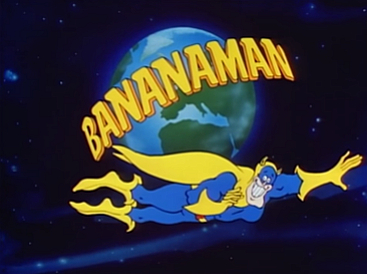
This is one of DC Thomson's success stories. During the eighties this guy was BIG. A satire of pretty much every American superhero, and often, the UK's law system. Everyone knows of the classic superhero story...a normal geeky teenager gets superpowers from something and is a super-awesome hero who everyone loves blahblahblahblah. DC Thomson's offices, 1979. A new comic was soon to come and it was to star a character the head man immediately loved. With the amazing humour talents of John Geering, a character was soon constructed. A big musclebound hero who was based inside little Eric Wimp, a 10 year old schoolboy. Seemingly cliched stuff, but what caused the hero's appearance is what really made it funny. When Eric eats a banana, an amazing transformation occurs! ERIC IS BANANAMAN!Perfect. Just the name seemed amusing. Next came Chiefy. An irish overeating police chief with a spinning blue light on top of his hat (Originally a Headress. 'Chiefy'? Headress? *GROAN*). Classic. Then General Blight, the enemy....and it was all set. What more's needed? The strip was in the first issue in 1980 and was an immediate success. Soon enough he was all over the issues. Letters page? Helmed by Bananaman. Front cover? Bananaman. Back cover? Bananaman. Middle publication? BANANAMAN. And the readers just loved it. But what was special about it other than Bananas? Simple. Bananaman was absolutely thick. And needed a talking crow to sort things out most of the time. He was also egocentric. 'Nononononono. You do not need the combination, Bananaman, because you have the strength of twenty men!' 'Oh yes...twenty...BIG MEN! *flex*' 'Cor. Pathetic, isn't he?' It only took three years for him to get on Television. That's how big he was. The BBC1 Series took it's satire appeal even further. Voiced by the Goodies, Bill Oddie, Tim Brook Taylor, and Graeme Garden. It lasted for Forty episodes, which isn't a bad run at all, and the animation, and writing, was surprisingly good. (In fact, I own the full box set and I enjoy quite it a lot.) As a result, many hilarious catchphrases sprang up and it even became pretty big in America, showing with fellow eighties TV smash Dangermouse.
The funny comments on the British law system were always a favourite, such examples being: 'And so, after the prison wardens had tucked them all in bed, Eddie the Gent and his Heavy Mob plotted a daring escape plan...' It was clearly lampooning our punishment systems! Then Chiefy always gave some of the best punchlines. 'I say, Chiefy. What's that smell?' 'We're grilling some suspects next door.'There was clearly a lot of fun going on behind the scenes and it showed. In 1987, however, Nutty, Bananaman's paper, folded. What happened to Bananaman? Well, he soon moved to the Dandy, where he still seemed to take up a fair amount of print space, and rightfully so! Even surviving the Dandy's 'makeover', it doesn't look like the lovable idiot is going anywhere. All we can hope is he moves onto the Beano when the Dandy's time is up.
He got so huge there were even plans for a live action movie at one point, but I believe it was shelved.
With lampoons of American superhero culture, including uncreatively named one off supervillians, which were replaced by people such as 'Captain Cream', 'Bubblegum Bert', 'Appleman', and 'Weatherman', along with 'Doctor Gloom', it was always full of laughs.
To purchase the Bananaman three Disc DVD boxset, I suggest Amazon or Play.com. Bananaman, a superhero which no doubt made Marvel gnaw on their pens for a long while!


 ) I'm here and ready to start with the first installment. One of the most controversial comics ever to come into existence in the United Kingdom.